Jan 132012
dave1 Dave Orrock joins the Pura team

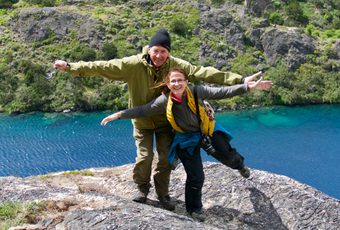
Dave Orrock in Torres del Paine National Park

As we arrive in 2012, we welcome Dave Orrock to the Pura Aventura team. He joins us a travel consultant so is here to help you plan your holidays to both Spain and Latin America.
Dave’s passion for Latin America began at an early age, with a 5 week trip to Ecuador and the Galapagos when still a teenager.
This spawned a love of wildlife, big landscapes and South America in general. Subsequent trips to Ecuador, Peru, Bolivia, Chile and Argentina over the next few years found him trekking, rafting, biking and looking after some rather stroppy capuchin monkeys.
There was also time spent trying to “save the cloudforest,” although Dave always found it a bit strange how much this incorporated chopping bits of it down.
He embarked upon a degree in Hispanic Studies, largely due to the fact that it was a four year course with the third year spent abroad. Spurning the more obvious charms of Spain, he divided the time between Santiago in Chile and Cusco in Peru, soaking up the atmosphere and trying to do some research on the Incas. After his third trip to Machu Picchu, he concluded that they were pretty cool.
Happily Spain’s charms did catch up with Dave eventually, and he spent 6 months as a tour leader in Andalucia, taking groups around cultural treasures such as the Alhambra and walking in the mountains. Along the way he developed a serious love affair with jamon.
For the last 5 years Dave has worked in sales and product for a well-respected tour operator, giving him the opportunity to discover even more Latin American countries along the way.
He’ll be writing more about his travels here in the near future but for now, he’s here on the end of the phone 01273 676 712 to answer your questions and help you arrange that perfect holiday to Latin America, or Spain.
In the meantime, here’s his top tip for Latin America, drum roll please….
“My single favourite journey in South America has to be crossing the altiplano from San Pedro in the Atacama Desert of Chile to the Uyuni Salt Flats in Bolivia. I’ve yet to discover anywhere with more dramatic, spectacular and plain surreal scenery.”
Jan 032012

The major fire which has been raging in Torres del Paine since the 27th December has now been put out and it appears that the park will re-open on the 4th January.

At Pura we have been getting updates from conventional news channels, our suppliers locally and our guides and people on the ground actually in and around Torres del Paine so we hope to be able to give you the most accurate information possible. As you can appreciate, information comes in dribs and drabs via different means so we can’t be 100% certain about anything right now.

area afectada incendio Fire in Torres del Paine

WHERE DID IT START?

The fire started in the area around the Refugio Grey, where the fire symbol is shown on the image above. The winds were blowing very strongly (gusting at up to 100km/h) towards the south. From the start point of the fire, the affected area appears very narrow on the image above. This is because frankly there is little to burn – to the one side you have the glacier, to the other, the mountains rise steeply. What this area does do is create a funnel in which the fire presumably could sit and really gain some serious heat and then momentum.

HOW MUCH OF THE PARK IS AFFECTED?

As you can see from the yellow circles on the bottom of the image, the affected area on day 1 was just 1.5 hectares, growing massively to 600 hectares on day 2. This then leapt to 3,500 hectares and finally 11,000 hectares on days 3 & 4.

Days 3 and 4 really represent the point at which the fire broke from the Paine mountains and split into two branches taking it along the land bridges to the south of the mountains. Those are much more open, rolling grassland areas so in dry weather are very easy prey for a fire of this size.

It would appear that the final damage will affect in the region of 12,000 hectares which equates to 5% of the park’s 242,000 hectare total. However, the fire has torn through what is really the most visited part of the park – including the Administrative centre of the National Park.

Of the areas affected, 1/3rd is woodland, 2/3 grassland though by looking at the image map above I would say that the proportion of grassland will be higher when final numbers are in.

Though the park looks set to reopen tomorrow, it will do so only partially. The areas around Refugio Grey and Paine Grande are not open. The boat across Lago Pehoe is not operating as Pudeto, the landing stage, simply isn’t there any more. Really anything to the west of Valle Frances is not likely to reopen at all soon and even then it’s going to look pretty bleak.

Valle Frances, the area around Los Cuernos and the Torres del Paine themselves are all open and unaffected. Hosteria Lago Grey is apparently unaffected though it sits in part of the Park which is not due to open tomorrow. It has been helping greatly in ferrying some of the 400 plus firefighters along Lago Grey in the hotel’s own boats.

The hotels in the park, such as Hosteria Grey, Explora, etc are all unaffected as they lie principally to the south of the lakes and to the south west of the Rio Serrano. If you see the outer limits of the marked red area (that affected by the fire) you will see that the bottom left edge follows a river – that’s the Rio Serrano. If the fire had jumped that river then it could have really got out of control.

There was a fire near the Valle Frances sector of the park but this has been put out  by 40 volunteers from the Hosteria las Torres and the refugios of the Fantastico Sur group (Refugio Grey, Refugio Paine Grande and Refugio Cuernos) so thanks to them it seems that Valle Frances is safe.

The weather has now changed to high wind and lots of rain so this really does the job much more effectively than humans can manage in such a remote area. Don’t forget also that by and large, helicopters can’t operate down here as it’s just too windy too much of the time.

It’s worth remembering that there are important areas of the park which are not affected and will be open fully by tomorrow. You won’t even notice the impact of the fire.

WHAT CAUSED THE FIRE?

We are yet to find out definitively the cause of the fire though some tourists have been detained in connection with the outbreak. It would appear that they were either having a bonfire (prohibited in the park) or one of them failed to properly control disposal of their waste, shall we say.

It’s normal when wild camping to dig a small hole for a loo, once done, you can then light your soiled loo paper to turn that to ash before you cover the hole again. This creates an ash layer which aids composting of the waste. It’s really not that difficult to do safely and properly – you just need to dig a sufficiently deep hole, wait to check that any flames are properly out (it doesn’t take long with loo paper) and to properly cover the hole.

WHO IS RESPONSIBLE?

If these stories are true then it’s probably a case of inexperience on the part of the visitors in question, if not negligence. However, it also calls into serious question the management of the park itself.

Comments on Chilean blogs and news sites are invariably rounding on the management of the park and/or the government for its failure to adequately control and manage visitors to Torres del Paine. With visitor numbers doubling or more in the past 10 years to some 100,000 annually, controls have changed little.

You do not need a permit to head out in the park to camp in the wild. In reality, that’s a scandal. It may well be time to have a look at the US National Parks model to really control and manage visitors to front and back lands of Torres del Paine. Take the 10% of the park which most people want to visit anyway (Glacier Grey and the Torres).

Improve the infrastructure there so that there are things like toilets and waste facilities so people aren’t digging holes any more. These don’t have to be permanent structures and can be entirely ecologically sound. Manage that area or those areas of the park to sustainably receive 99% of those 100,000 visitors.

The remaining areas of the park should then be kept open only for people with permits. They should be people who are experienced or are being guided by experienced people. Their numbers would be far, far lower as the costs would be higher.

I think I am right in saying that, by and large, experienced outdoors people are very rarely the cause of wildfires. It usually seems to be either nature (lightning or simple combustion) or careless and inexperienced humans.

THE COSTS OF THE FIRE

Where the fire passed through, the grasslands will presumably be back to some semblance of normality by next year, the woodlands are going to take far longer.

As a tour operator specialising in Chile and in Torres del Paine in particular, it’s very upsetting to see damage on such a large scale being done to this stunning environment.

It’s also very upsetting on a more personal level as we know the potential impact this will have on the livelihoods of the guides, porters, drivers, hoteliers, restauranteurs, etc who rely almost entirely on a small window of work between January and March.

It seems apt to end on an environmental note. Though Paine is often referred to as pristine, it is worth remembering that the area was largely burned in the 19th century with the arrival of cattle ranchers. They took out matches to burn down the native forests which covered the landscapes.

It’s really the native woodlands which have been burned this past week which are the greatest loss since we lose areas which have never before changed at the hands of human interference.

Nov 162011
lunatics Antarctic Ice Marathon

Serious kit, serious conditions, seriously bonkers...

Fancy a bit of a challenge?

We think this one takes the biscuit. How about running a marathon or 100km? Now try doing it in the coldest, windiest, highest, driest continent on the planet. Yes, the 2011 Antarctic Ice Marathon is upon us!

Held at 80 Degrees South, at the foot of the Ellsworth Mountains, just a few hundred miles away from the South Pole the Antarctic Ice Marathon is the southernmost marathon, beating its nearest rival by a margin of about 3,000km!

As if a normal marathon isn’t daunting enough, here you are guaranteed no crowds, not even penguins, and an average temperature of -20C, oh, and 50kmh winds and a dash of 700m altitude.

I have to say that reading the testimonials from 2010 does rather pique my interest as it’s just so bonkers though in all honesty a rather more manageable Antarctic Cruise is probably more realistic.

You’re too late for the 2011 event which happens on the 30th November but 2012 registration.

If the spirit of Christmas is upon you, policewoman Yvonne Brown is running the marathon this year in aid of the Neuroblastoma Alliance. This is an aggressive form of childhood cancer which took away Yvonne’s Jack two years ago and earlier this year took away Felix down here in Hove.

Visit Yvonne Brown’s Just Giving Page .