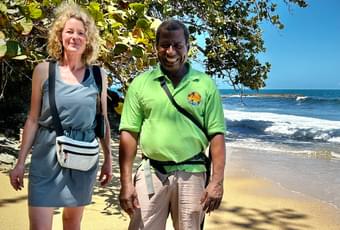
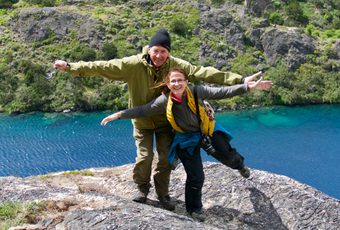
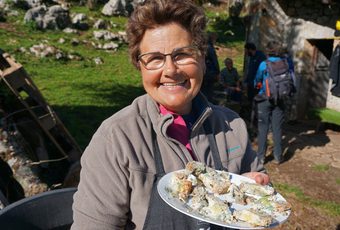
Over the past 7 years Camilo has proved to be one of our most popular guides so we think it’s time we introduced him properly.
Camilo is an expert in the Atacama Desert of northern Chile, a beautiful area of high desert plains, salt flats, volcanoes, Andean peaks, lagoons and sand dunes.
As he himself puts it, “The Atacama is a unique place in the world, full of genuine Andean tradition, with spectacular landscapes, views and walks. Every spot in the desert and the mountains are something unique, difficult to describe with words. As long as you walk in San Pedro, you are discovering new things”.
Given that altitudes range from 2,000m to nearly 6,000m and the road infrastructure is very limited, it really isn’t the sort of place you would want to be without a guide to show you round. We think Camilo is the best of the bunch.
Incredibly calm, he exudes a relaxed authority which allows you to just hand over the reins of your holiday. As you dig a little deeper though, you might discover a bit more about how much he has done in his time up here. For instance, it was he who was chosen by the government to establish the Camino de Chile (a massively long footpath which will eventually link north to south of Chile) across the Atacama.
He also seems to know all of the many, and increasing, number of observatories up here. He also knows about the wildlife, the culture, the stars, I could go on. He’s a sort of outdoor renaissance man. My mother still goes a little dewy eyed at the mention of Camilo after her trip to Chile in 2009. She isn’t the only one by all accounts.
Camilo’s always up early as he doesn’t want to miss any minute of the day. Most days are spent touring the Atacama whether walking, mountain biking, riding horses or something more relaxed like visiting cultural sites near San Pedro.
For Camilo, the most important thing as a guide is to impart an appreciation of the culture and history of San Pedro de Atacama. He is also passionate about respect and care of the Atacama’s exotic and fragile ecology.
When I asked Camilo about what makes this area different form the rest of Chile he said:
“The Atacama is the driest desert in the world with a unique and fragile ecosystem combining amazing mountains, lakes, little Andean towns and wildlife. And unlike the south of Chile, the sun always appears!”
If you would like to be guided by Camilo then have a look at our Atacama Patagonia walking holiday to Chile, alternatively we offer an almost limitless range of tailor made holidays to Chile.
At Pura Aventura we try to make every destination special and different, a key part of that is our guides. They all make the effort to make our clients feel at home and get the most from their holidays. Here we interview our key man in the Pyrenees, Jaime. Or Jaime Lahoz Ortiz de la Tabla if you want all the bells and whistles!
Where do you live?
Cerler, Pirineo de Huesca.
What are your hobbies?
I’m very active. In winter I mainly ski though I also like snowboard and telemark. In summer I mountain bike.
Music is very important for me, I am addicted to Spotify. I recently started learning to play guitar. At this rate, in about 100 years I might make a sound which passes as music.
How did you get involved with Pura Aventura?
I got involved in Pura as a shareholder in 2003 through Xabi, one of the players in my Rugby team and one of the founders of Pura Aventura.
Nowadays I am in charge of our ski holidays here in Celer, although some times move to another areas to help some Pura’s colleagues when they have big groups, for instance in the Picos de Europa.
What do you do with Pura’s clients on a ski week?
Basically I teach the clients to ski or snowboard if someone asks for it.
I am also there to help clients get their equipment, hand out the lift passes, show them around, advise on the best time to hit the slopes, tell them which slopes are best at the moment.
I also am on hand to help them with any thing they need, making life in Cerler as easy as possible for them. I want them to just relax and enjoy their holiday.
Because I live in Celer I know all the restaurants, shops, bars, etc. It means that I can point you in the right direction for the best and most authentic experience.
What is the most important task you have as a Ski teacher?
Sometimes I’ll get a group which includes complete beginners, afraid to ski as well as advanced piste bashers. I try to make sure that every student gets exactly what they need.
The way I teach each person is different. What matters most is that everyone enjoys themselves!
For a beginner it might be enough to learn to slide slowly downhill while I hold their hands. For teenagers in particular I usually have to teach them not to go too fast for their level. I try to make is so that everyone gets to access and enjoy this fantastic environment.
What do you think makes Celer different to other ski resorts?
Lots of things.
It’s big enough to have lots of runs for everyone to enjoy but it feels really intimate. It’s never crowded so you don’t get long queues. Sometimes you will even be on your own on a run. It also means that beginners can learn safely and advance only as fast as they want.
It’s easy to get around the slopes because the lifts are located strategically. From each station there is a ski run for every level, this makes easier to organise groups according to their level.
Cerler is a real village which happens to have a ski resort. As a result, it feels like the real Spain – great food, sensible prices and a stunning environment.
I guess ultimately though it’s the people who make Cerler different. The environment is quieter and more relaxed, I know almost everyone on the slopes. Also, they know that the only British people here are Pura customers and so are always willing to help.
I remember one day one of our clients dropped his passport and wallet on the slopes, without realising it. One of the other teachers in resort found it and, seeing that it was a British passport, came to find me. I gave back the wallet to the client before they even knew it was missing!
I love this story because I think it’s impossible to think that this would happen in a ‘normal’ ski resort. Sometimes a small ski resort can be a great ski resort!
What would you say to the readers of this newsletter?
Come to Spain and discover that my country is more than just sun and beaches. Come to Cerler, improve your skiing and have a lot of laughs. At least I promise to try!
Galapagos Guides
When planning a Galapagos cruise holiday, everyone asks about the boat, many ask about the itinerary, few about the guide.
And yet, there is arguably no greater influence on the quality of your Galapagos cruise experience than your guide.
As we used to say in guiding circles here in Europe: ‘A bad guide can ruin any tour, a good guide can make any tour great.’
The good news in the Galapagos is that there are stringent controls in place to ensure good standards throughout the guiding community.
Nevertheless, it would be foolish to suggest that all guides are created equal. The question then is, how can you do to give yourself the best chance to explore in the company of a truly inspiring guide?
How do you become a guide?
To become an approved naturalist guide, you have to study, generally under the auspices of the Darwin Foundation. Examinations are delivered by the Galapagos National Park Authority itself.
The training comes from three possible sources: the Catholic University of Quito, the Galapagos national Park Authority and the Ecuadorian Ministry of Tourism.
Studies cover a fairly startling array of topics, relating to the wildlife, conservation, history, geography, geology and environment of the Galapagos and continental Ecuador. Their studies also cover less obvious subjects such as etiquette, ethics, teaching techniques, cartography, wild camping, survival and first aid.
Exams are held roughly every 18 months (there have been 27 exams held since 1975) on each of the main populated islands of the Galapagos archipelago: Santa Cruz, San Cristobal and Isabela.
Participants must score over 80%, from that pool the best 30 scoring candidates qualify as guides.
Beyond guide levels
There is a very logical and sensible seeming progression for guides in the Galapagos Islands. According to latest figures, there are 203 level I, 98 level II and 77 level III guides as well as 38 diving guides.
Level I guides are those who have at least a high school diploma and have passed the Naturalist Guide course.
Level II guides are those who have at least four years’ experience and pass a further examination.
Level III guides are those who have degrees or masters in tourism or biology and related subjects who speak at least two foreign languages and pass a further examination.
On the face of it, most reasonable people would assume that a level III guide is better than a level I guide.
However, it has been nearly 10 years since a level II exam has been held. It is nearly 20 years since the last level III exam took place.
In truth therefore, all you can say with absolute confidence about level III guides is that they have been around a long time.
Given that the opportunity for guides to move between levels is effectively non-existent, it is crucial to look beyond the numbers.
Eyes and ears of the National Park
You can only enter the bounds of the Galapagos National Park if you accompanied by an officially qualified guide. The system of guides is an integral part of the work of the park authorities.
A guide’s studies do not end with their exams by any stretch of the imagination. Once qualified, they have to continue to attend seminars and workshops as well as keep up to date with the latest materials and information.
Nor does the supervision end there. As well as the responsibility to care for and educate their guests, guides have a responsibility to submit a report to the Galapagos park authorities after each and every tour they lead.
The report covers the number of tourists in the group, the activities, landing sites and any observations made during their visits as well as any complaints.
It is this constant and comprehensive reporting which allows the National Park Authority to both monitor guide performance and to keep track of changes across the archipelago.
If you think it sounds like mere lip service, you should check out their published monitoring data (Spanish only) they cover erosion, compacting, contamination, introduced species, even the number of other visitors encountered.
Of course, these reports also give an insight into the performance of the guides themselves. Bear in mind that guides have to take a week long course every two years to keep their licence current.
Choose the right boat, you’ll get the right guide
Whilst you can fairly safely say that a level III or level II guide has a great deal of experience, you cannot safely say that a level I guide does not have the same level of experience.
You can quite easily find a situation whereby a talented level I guide found themselves gainfully employed from day one after their graduation. They will never have had reason to attempt to add a stripe to their sleeve.
They will be employed by the best boats at the best rates and will live very well by their profession.
At the same time, a less talented guide may have found that work was less easy to come by. They were therefore motivated to go for level II or level III qualification in order to get work on those boats which advertise only ever to use level III guides – a relatively far smaller pool of guides and therefore a less competitive job market.
The truth of the matter is that a good boat owner is going to know the value of great guides. It doesn’t make sense for them to put together a wonderful boat, delicious food and then nickel and dime you on the guide.
On this basis, I would personally choose a level I guide employed by a good boat as a safer bet to deliver an outstanding Galapagos cruise experience.
Conclusion
If you are on a budget boat, you should expect a budget guide. If you are on a first class boat then you can reasonably expect to be led by a first class guide.
In all honesty, pick your boat and pick your itinerary carefully. Ask questions about the guide but don’t treat their ‘level’ as indicative of much beyond their age. Do ask about their experience, who they are, why the boat operators choose to work with them.
Bear in mind that guides are freelancers. The best boats have a select pool of guides since many of the best guides choose to work part time.
A boat operator may well not be able to tell you who will guide you months ahead of time. You can still ask them to give you the story of, say, two guides they work with regularly.
If you are being nosey, you can find out what level they are afterwards! Directory of guides, split by level.
Find out more about our Galapagos cruises or read our guide to the Galapagos.